From Sleepless Nights to Peaceful Rest: How Pet Monitoring Gave Me Back My Calm
Ever lie awake, heart racing, wondering if your dog is okay at home? I did—until I discovered pet safety monitoring. It wasn’t just about cameras or alerts; it became a lifeline that eased my anxiety, improved my sleep, and helped me show up more fully in my own life. This is more than tech—it’s peace of mind, one quiet night at a time. I remember sitting in a work meeting, nodding along, while my mind was miles away—was my golden retriever, Max, pacing by the door? Was he drinking enough water? Did I leave the back gate latched? That constant hum of worry wasn’t just distracting—it was exhausting. And I know I’m not alone. So many of us pour so much love into our pets that we forget to care for ourselves in the process. What if I told you there’s a way to stay connected, not out of fear, but out of love—calmly, clearly, and with confidence?
The Hidden Cost of Worry: When Love for Your Pet Keeps You Up
Let’s be honest—when we say we’re worried about our pets, we often downplay how deep that worry runs. It’s not just a passing thought. It’s the reason you wake up at 3 a.m. and instinctively reach for your phone. It’s the reason you skip that after-work coffee with friends because you don’t want to be too far from home. That knot in your stomach when the thunderstorm rolls in and you’re stuck at the office? That’s not just concern. That’s real, physical anxiety. And over time, it takes a toll—not just on your sleep, but on your mood, your focus, even your relationships.
I used to think I was just being responsible. But looking back, I was living in a state of low-grade panic. I’d imagine Max chewing on the couch, or worse—getting out and running into the street. I’d replay the latch on the gate in my mind, over and over. Was it closed? Did the wind push it open? My imagination ran wild with worst-case scenarios, even though, logically, I knew Max was safe most of the time. The truth is, love can be a double-edged sword. We care so deeply that we can’t let go—even for a moment. And that constant mental check-in? It doesn’t protect our pets. It drains us.
Sleep suffered the most. I’d lie in bed, mind racing, trying to convince myself that everything was fine. But without proof, my brain wouldn’t shut off. I’d wake up tired, irritable, and already behind before the day even started. I wasn’t just losing sleep—I was losing myself. I didn’t have the patience I used to with my kids. I snapped at small things. I stopped doing the hobbies I loved because I was too drained. It wasn’t until a close friend gently said, “You seem so tense lately,” that I realized: this wasn’t normal. This wasn’t sustainable. And it wasn’t fair—to me, or to the people who loved me.
Discovering the Right Kind of Watchful Eye: Not Just a Camera, but a Companion
I didn’t set out to become a tech enthusiast. I just wanted to stop worrying. My friend suggested a pet camera—not one of those clunky old models with grainy footage, but something simple, intuitive, and kind of… gentle. She showed me how she checked in on her cat during her lunch break, just to see if he was napping in his favorite sunspot. “It’s like a little hug from across town,” she said. That stuck with me.
So I did some research—not on megapixels or storage specs, but on how it felt to use. I wanted something I could open on my phone without frustration, something that didn’t require a manual just to turn it on. I chose a system with clear, wide-angle video, night vision, and a simple app that worked whether I was at work, at the gym, or stuck in traffic. Most importantly, it had sound alerts—if Max barked or whined, I’d get a gentle notification, not a blaring alarm that startled me.
The first time I used it, I held my breath as the screen loaded. And there he was. Max, curled up on his dog bed, one paw twitching as he dreamed. I exhaled like I hadn’t in weeks. It wasn’t just relief—it was connection. I didn’t need to call a neighbor. I didn’t need to drive home early. I could see, with my own eyes, that he was safe. That night, I slept better. Not because the camera did anything magical—but because my mind finally had proof.
Then came the real test: a thunderstorm. The sky turned dark, the wind picked up, and I was at a school event for my daughter. My chest tightened. But instead of panicking, I opened the app. Max was under the table—his safe spot—but calm. I used the two-way audio to say, “It’s okay, buddy. Mama’s here.” He lifted his head, ears perked, and settled back down. I stayed at the event. I didn’t leave early. I didn’t miss a thing. That night, I realized this wasn’t about surveillance. It was about presence. It was about being able to care without being consumed.
From Obsession to Trust: How Constant Access Reduces Anxiety
Here’s something surprising: having constant access to my pet didn’t make me check in more. It made me check in less. At first, I admit, I was glued to the app. Every little noise, every movement, and I’d peek. But over time, something shifted. I started seeing patterns. Max barked when the mail truck passed, but he settled right after. He liked to nap by the window in the afternoon. He drank water every few hours, just like I hoped he would.
With each small observation, my trust grew—not just in the camera, but in Max, and in myself. I realized he was more resilient than I gave him credit for. And I didn’t need to micromanage his day to keep him safe. The more I saw him calm, the calmer I became. My brain stopped jumping to worst-case scenarios because it had real data. Instead of imagining disaster, I saw reality: a dog living his best life, even when I wasn’t there.
That mental shift was everything. I stopped feeling guilty for leaving him. I stopped second-guessing my choices. I could focus at work, enjoy time with my family, and actually relax during my evenings. The camera didn’t fix everything—but it gave me the space to breathe. And in that space, I found something I thought I’d lost: peace. It wasn’t instant. It took a few weeks of consistent use, of letting go little by little. But each time I resisted the urge to check, and each time I saw him safe when I did, it reinforced a new habit—trust instead of worry.
And here’s the thing about trust: it’s contagious. When I trusted that Max was okay, I started trusting myself more too. I made decisions with more confidence. I said yes to things I would’ve avoided before—like a weekend getaway with friends. I knew I could check in if I wanted to, but I also knew I didn’t have to. That freedom? It was priceless.
Better Sleep, Better Self: The Ripple Effect on Personal Growth
The first full night of uninterrupted sleep felt like a miracle. I woke up without the fog, without the weight. I made breakfast with energy. I laughed with my kids instead of snapping. I even had the mental clarity to start that online course I’d been putting off for months. It wasn’t just about rest—it was about reclaiming my life.
Better sleep changed everything. I had more patience. I listened more. I felt more like the person I wanted to be—the mom, the wife, the friend I knew I could be when I wasn’t running on empty. I started noticing small joys again: the way the light came through the kitchen window in the morning, the sound of my daughter practicing piano, the quiet moments with my husband after the kids were in bed.
And because I had more emotional bandwidth, I began investing in myself. I joined a local book club. I started journaling again. I even signed up for a gentle yoga class—something I hadn’t done in years. None of these were huge changes, but together, they added up. I wasn’t just surviving anymore. I was growing. And it all started with one small shift: knowing Max was safe while I slept.
I won’t pretend the camera did it all. But it removed a major roadblock. It gave me the mental and emotional space to focus on what mattered. When you’re not constantly drained by anxiety, you have more to give—to your family, to your passions, to yourself. It’s like clearing clutter from your mind. Once that one big worry was lifted, everything else had room to breathe.
A Routine Transformed: Integrating Monitoring into Daily Life
The key to making this work wasn’t just having the device—it was using it wisely. I didn’t want to become dependent on it, or let it turn into another screen I couldn’t put down. So I set some gentle boundaries. I decided not to check in more than a few times a day—unless there was a storm or something unusual. I used the schedule feature to get alerts during key times, like when Max usually ate or took his afternoon nap. That way, I wasn’t guessing—I was informed.
Placement mattered too. I put the camera in the living room, where Max spends most of his time, at just the right height so I could see him clearly but not intrusively. I made sure it wasn’t pointing at anything private, and I kept the volume low so it didn’t disturb him. It was important to me that this tool served both of us—not just me, but Max too.
I also involved my family. My kids love using the two-way audio to say hi to Max when they’re at school. “Daddy, look! Max wagged his tail!” They feel connected too, and it’s become a sweet little ritual. We even use it to make sure he’s not barking when the doorbell rings—so we can train him calmly over time. It’s not about control. It’s about care.
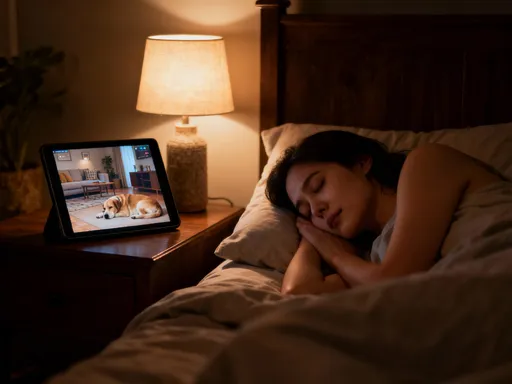
And at night, I set a routine. After I tucked in the kids, I’d do a quick check—just a glance to see Max sleeping peacefully. Then I’d close the app and leave it alone. That one look was enough. It became part of my wind-down ritual, like brushing my teeth or reading a few pages. Simple. Calming. Effective.
More Than a Pet, More Than a Device: Strengthening the Human-Animal Bond
I used to think that being present meant being physically there. But this experience taught me something different. Presence isn’t just about location—it’s about attention. And in a strange way, the camera helped me pay better attention to Max. I noticed things I never would have seen before: how he stretches after a nap, how he tilts his head when he hears a bird outside, how he circles three times before lying down—just like always.
I started adjusting his routine based on what I saw. I realized he was more active in the evenings, so I made sure to take him for a longer walk after dinner. I noticed he ignored his water bowl in the morning, so I started refilling it right when I got home. These weren’t big changes, but they made his life better—and mine too.
And honestly? I feel closer to him now. Not because I’m watching him all the time, but because I understand him more. I see his habits, his comfort zones, his little quirks. It’s deepened our bond in a way I didn’t expect. This isn’t about replacing real time together. It’s about enriching it. When I come home, I’m not distracted by worry. I’m fully there—with energy, with love, with presence.
My husband noticed it too. “You’re calmer around Max now,” he said one evening. “You don’t hover. You just… enjoy him.” That hit me. Because it’s true. I’m not managing him. I’m loving him. And that’s what we all want, isn’t it? To love without fear, to care without burnout, to be fully here with the ones we cherish.
Peace That Spreads: When One Small Change Uplifts Your Whole Life
It’s amazing how one small solution can create waves. What started as a way to stop checking my phone at night became a gateway to a calmer, more centered life. I sleep better. I think clearer. I show up with more love. I’m not perfect—I still have busy days, stressful moments, days when I forget to charge the camera. But the baseline has shifted. The constant hum of worry is gone. In its place is a quiet confidence: I’ve done what I can. I’ve prepared. I can trust.
This isn’t about technology replacing human care. It’s about technology supporting it. It’s about using tools not to escape life, but to live it more fully. When we ease one burden, we make room for joy. When we protect our peace, we protect our relationships. When we take care of ourselves, we have more to give.
If you’re lying awake tonight, wondering if your pet is okay, I want you to know: you’re not alone. And you don’t have to carry that weight. There’s a gentler way. A way that lets you love deeply without losing yourself. It might be a camera. It might be something else. But whatever it is, let it be a bridge—not a barrier—to the life you want.
Because peace isn’t found in perfection. It’s found in progress. In one quiet night. One deep breath. One glance at a screen that shows your dog sleeping soundly. And in that moment, you remember: you’re okay. They’re okay. And that’s enough.